Many parents searching for math enrichment wonder how the Seriously Addictive Mathematics (SAM) approach actually differs from other traditional programs. While many programs focus on computational speed and repetitive drills, the SAM Singapore Math is different.
Here are top 5 differences and why our approach continues to lead the world in mathematics education.
Most alternative programs rely heavily on “muscle memory.” They assign a child 20 or 30 nearly identical problems (e.g., 25 X 6, then 26 X 3, etc.) until the child can perform the calculation on autopilot. While this builds speed, it often results in passive learning where the brain switches off.
At SAM, we take a different approach inspired by the work of Zoltán Dienes, a pioneer in the psychology of learning mathematics. Dienes’ Variability Principle suggests that true understanding doesn’t come from repeating the same task, but from encountering the same concept in varied forms.
We apply this through Incremental Variation. In our curriculum, every problem introduces a purposeful, slight shift in logic or context.
We understand that mathematics is far more about comprehension than it is about facility with computation.
Our model-based approach (e.g., Bar Modeling) is the missing bridge that other programs lack. When a child translates the text of a question into a visual model, they are not just “drawing”; they are organizing, processing, and deeply comprehending the information.
This method is grounded in the Concrete-Pictorial-Abstract (CPA) framework, a theory developed by American psychologist Jerome Bruner. Bruner’s research demonstrated that for students to truly grasp abstract concepts (like algebraic equations), they must first navigate through:
By anchoring our curriculum in this research, we ensure students don’t just manipulate symbols they don’t understand. They build a mental “scaffold” that supports higher-level problem solving.
Most parents intuitively understand that learning a skill like the piano or tennis isn’t about listening to a lecture. You don’t expect a sports coach to simply shout instructions to a large group; you expect them to watch the individual athlete, correct their specific grip, and adapt the training to their physique.
At SAM, we recognize that Mathematics requires this exact same level of personalization.
Unlike “classroom style” programs that move students through a fixed curriculum regardless of their understanding, we treat math like a coached skill:
At SAM, we move away from the passive, lecture-style model. Instead, we employ the Socratic Method of teaching- Instead of lecturing, the teacher asks probing questions to explore to encourage the student to think and discover solutions. This style is only possible in a small classroom with personalized interaction.
As students become self aware of their own problem solving abilities, they gain in confidence. It is fairly common for us to hear in a classroom:
“I am really good at Math!”
“School Math is so easy I finish my homework in the hallway.”
“Can I have more homework?”
This confidence is the direct result of a student realizing they can think their way through a problem on their own.
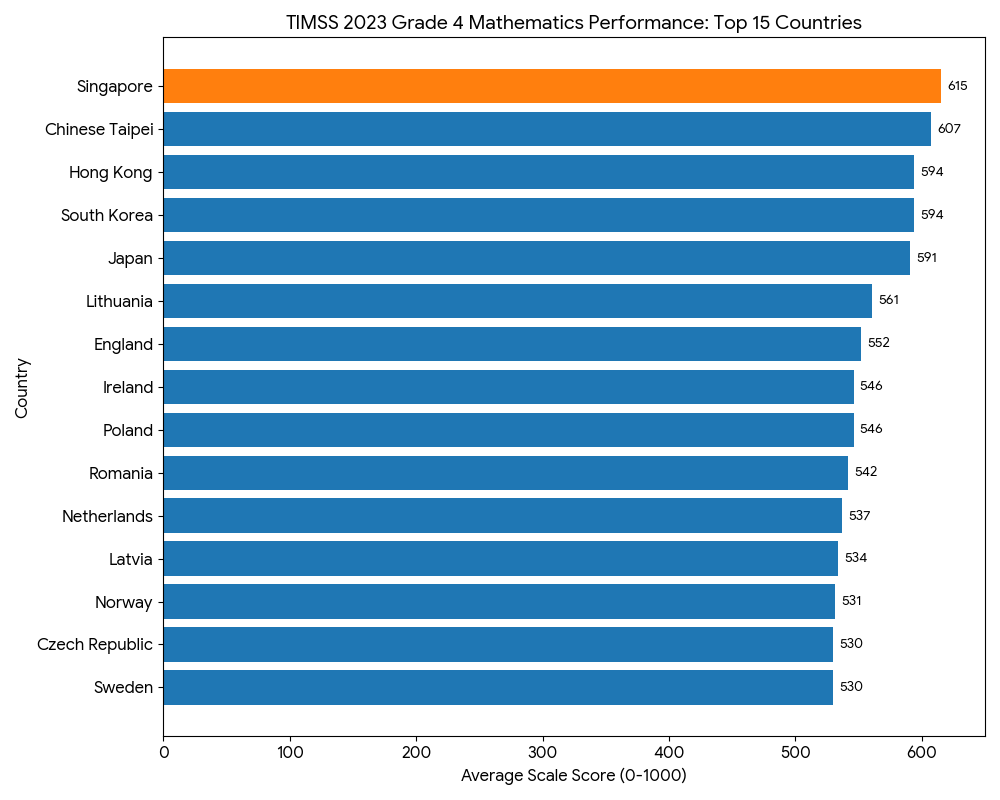
Singapore students consistently rank #1 in the world in mathematics in international benchmark exams conducted by Trends in International Mathematics and Science Study (TIMSS) and Program for International Student Assessment (PISA). Both focus on the depth of knowledge, reasoning and application of Mathematics. For students to achieve a high score they need to have been trained in a curriculum that prepares them to be creative thinkers.
Singapore has been been performing spectacularly for the last 30 years. The results from the latest TIMSS test is shown below.
Interesting, but there is more:
At SAM, we deliver the authentic after-school enrichment curriculum used by students in Singapore. Designed to go beyond the standard national syllabus, our program offers greater depth and rigor while retaining the core principles that make Singapore Math the global gold standard.
If you choose SAM, you are moving your child into that distribution of excellence, equipping them with the same world-class curriculum that produces the highest-performing students on the planet.
Every child has the potential to be a “math person” when they are given the right tools to think logically. We invite you to schedule a Diagnostic Assessment at one of our centers located near you. We will identify your child’s current strengths and any foundational gaps to create a roadmap for their success.